

The Importance of Building an Online Community

The current world has been consumed by seemingly limitless online connectivity, and it is easy to see why there is value in establishing an online community. Building an online community can provide a tangible benefit to any individual or organization, as it increases their visibility while enhancing their public relevancy. For example, without an online presence, a business or individual will remain anonymous and go undiscovered. An online community can serve as a useful tool that can be leveraged to strengthen a professional or organization’s relationships with its surrounding audience.
Making the effort to build an online community requires consistent effort and research. It is important to understand the importance of a focus that aligns with the mission of the company or an individual. Refining attention to the target audience can make all the difference in building an online community. Furthermore, developing an online community can involve elements of communication, engagement, and ambassadorship that must each be understood in order to build a successful and long-lasting network.
Communication is a vital component in building an online community. People need to recognize what is being said and how it is being perceived. Additionally, understanding the messages that are exchanged is paramount, as it allows for feedback and furthers discussion within the community. It is essential that a brand or an individual project their individual tone and style to set their community apart from the rest.
Engagement is equally crucial when trying to build an online community. If an individual or company is not engaging with their audience, then it is very likely that their presence will become irrelevant. Understanding the culture of the audience members, such as the topics that interest them, and creating content that resonates with them is an excellent way to gain engagement. Similarly, understanding the interests of the audience can allow for discussion and interaction, which further strengthens their connection with the audience.
Lastly, having ambassadors-or loyal followers-that support the mission and identity of the online community is beneficial to its success. These ambassadors can help spread awareness and do the company’s marketing for them, while giving them the trust and support they need to help build their online community.
In summary, building an online community can be a tedious obstacle, but with the right knowledge, anyone can construct. Businesses can benefit from creating an online community of like-minded individuals who interact, advise, and advocate on their platform. Doing so boosts brand awareness and provides a competitive edge. Starting now is important if a business wants to be ahead of the competition and attract dedicated and passionate people who share the same values. In addition, conversations on a community platform celebrate the lives of its members.
How SEO is Like Baseball

The game of baseball, with its rich history and passionate fan base, is often used as a metaphor for various aspects of life. From teamwork and strategy to perseverance and competition, baseball mirrors many aspects of our society. One unexpected connection that can be made is between baseball and the world of Search Engine Optimization (SEO). While these two may seem like unrelated topics, there are actually several similarities between the two.
Just like in baseball, where every team starts with zero wins and zero losses at the beginning of a new season, SEO requires a fresh start with every new project. No matter how successful or unsuccessful your previous endeavors were, every new website or campaign begins from scratch. This is because search engine algorithms are constantly evolving, and what worked in the past may not yield the same results in the present. Just as baseball teams cannot rely on their past achievements to guarantee success in the future, SEO professionals must constantly adapt and learn to stay ahead in the game.
Another similarity between baseball and SEO is the importance of practice and preparation. In baseball, players spend countless hours honing their skills through drills, batting practice, and studying their opponents. Similarly, SEO professionals must invest time and effort into understanding the intricacies of search engines and optimizing websites accordingly. Like baseball players, SEO experts must be knowledgeable about the latest trends and techniques to ensure their strategies are effective.
Mastery is also a crucial aspect of both baseball and SEO. In baseball, players strive to become masters of the game, consistently performing at their best to help their team win. Similarly, SEO professionals aim to master the art of optimizing websites to improve their ranking on search engine results pages (SERPs). Just as a baseball player’s ultimate goal is to hit a home run or win the World Series, an SEO expert’s objective is to secure the top spot on the SERPs and drive traffic to their website.
Furthermore, both baseball and SEO are fiercely competitive fields. In baseball, teams compete against each other for the ultimate prize – the World Series championship. Similarly, in the world of SEO, websites compete for the top positions on the SERPs. It is a constant battle to stay ahead of competitors and attract more organic traffic. Just as baseball teams strategize to outsmart their opponents, SEO professionals must employ tactics and techniques to outperform their competitors in search engine rankings.
Lastly, success in both baseball and SEO requires a long-term perspective. Baseball seasons are not won in a single game or even a single inning. They require consistent performance and the ability to bounce back from setbacks. Similarly, SEO campaigns are not overnight successes. It takes time to see the results of optimization efforts, and there will be challenges along the way. Patience and perseverance are essential qualities for both baseball players and SEO professionals.
In conclusion, the practice of SEO shares several similarities with the game of baseball. Both require a fresh start, practice and preparation, mastery, competition, and a long-term perspective. Just as baseball players strive for victory on the field, SEO professionals aim for success in the digital world. By understanding the parallels between these two seemingly different realms, we can apply the lessons learned from baseball to enhance our SEO strategies and ultimately hit a home run in the game of search engine optimization.
Who’s On First?
Understanding the Importance Of Keywords and Competitors Online

In the world of online business, understanding your position and competition is crucial. Just like in the popular baseball joke by the legendary comedian duo, Abbott and Costello, knowing “Who’s on first” is the starting point for success. In this article, we will explore how knowing your business competitors and utilizing proper keywords can help you improve your website’s ranking and attract potential customers.
To begin with, it is essential to have a comprehensive understanding of your own business. Before diving into the world of keywords and competitors, take the time to analyze your business’s goals, target audience, and unique selling points. This clarity will serve as a foundation for your online strategy, enabling you to align your website’s theme, keywords, and content with your business objectives.
Once you have a firm grasp of your own business, the next step is to identify your competitors. Knowing who your competitors are is crucial as it helps you understand the landscape in which you operate and allows you to differentiate yourself from the competition. By studying your competitors’ websites, you can gain valuable insights into their strategies, identify their target audience, and learn from their successes and failures.
One effective tool that can aid in competitor analysis is a page analyzer. A page analyzer provides you with detailed information about your competitors’ web pages, including the keywords they are targeting, the type of traffic they attract, and their conversion rates. This valuable data can help you identify gaps in your own strategy and optimize your website accordingly.
The HTML of a web page plays a significant role in its ranking on search engine results pages. It consists of various elements, including meta tags and title tags, which communicate the theme and keywords of the site to search engines. By carefully optimizing these HTML elements, you can improve your website’s visibility and increase the chances of ranking higher in search engine results.
When analyzing your competitors’ web pages, pay close attention to their HTML structure. Look for patterns in their meta tags and title tags, as these elements are a powerful indicator of the keywords they are targeting. By analyzing your competitors’ HTML, you can gain valuable insights into the keywords that are most effective in driving traffic and conversions.
Armed with this information, you can effectively optimize your own website’s HTML. By incorporating relevant keywords into your meta tags and title tags, you can increase your website’s visibility on search engine results pages. However, it is important to strike a balance between keyword optimization and maintaining a user-friendly experience. Keyword stuffing can lead to penalties from search engines and deter potential customers from engaging with your site.
In conclusion, understanding “Who’s on first” is crucial in the game of online business. By identifying your competitors and analyzing their web pages, you can gain insights into their strategies and leverage that knowledge to improve your own website’s ranking. Furthermore, optimizing your website’s HTML with relevant keywords can significantly increase its visibility on search engine results pages. Remember, success in the online world requires you to know your business inside out, but it also demands a keen understanding of your competitors and the strategic use of keywords.
Preventing and Responding to Bullying and Cyberbullying

Bullying has been a long-standing issue that has affected countless individuals, causing both physical and emotional harm. Victims of bullying often feel helpless, humiliated, angry, depressed, and in some cases, even suicidal. What is even more alarming is that with the advent of technology, bullying is no longer confined to the school grounds or street corners. It has found a new platform in cyberspace, where it can occur relentlessly, twenty-four hours a day, and reach hundreds of people anonymously. This new phenomenon is known as cyberbullying.
The rise of cyberbullying is deeply concerning, and it is crucial that we equip ourselves with knowledge and best practices to prevent and respond to this growing problem. Here are some practical tips for dealing with a cyberbully:
1. Seek support from trusted individuals: The first step in combating cyberbullying is to reach out to people we trust for encouragement and support. This can be a parent, teacher, counselor, or trusted friends who have a zero tolerance policy for any form of bullying. Talking to these individuals can provide the necessary emotional support and guidance to navigate through the challenging situation.
2. Distance yourself from social media: When dealing with cyberbullying, it is essential to take a break from social media, texts, and emails. Engaging with people who support and uplift you in real life can help restore your confidence and remind you that you are not defined by the hurtful words or actions of others.
3. Do not respond to messages or posts: It is crucial not to engage with the cyberbully. Responding to their messages or posts will only fuel their behavior and provide them with the attention they seek. Instead, maintain your composure and ignore their provocations.
4. Keep an offline diary: Documenting the incidents of cyberbullying is vital for both personal validation and legal purposes. Save any evidence of the cyberbullying, such as printing emails, taking screenshots of text or social media messages, and jotting down details about the days, times, and people involved in the bullying incidents. This documentation can be invaluable when reporting the bullying to authorities or seeking legal action.
5. Prevent further communication: Most social media platforms and messaging apps provide blocking features that allow you to prevent further communication from cyberbullies. Utilize these tools to protect yourself from further harm and harassment.
6. Do not retaliate: It is crucial to resist the urge to retaliate against the cyberbully. Responding with aggression or sinking to their level will only escalate the situation. Instead, focus on documenting their communication and seeking appropriate channels to address the issue.
Preventing cyberbullying starts with education and awareness. By equipping ourselves and our children with the knowledge and best practices to prevent and respond to bullying, we can build a society that refuses to tolerate such behavior. Online platforms and social media companies also have a responsibility to create a safe and secure environment by implementing robust reporting systems and enforcing strict policies against cyberbullying.
In conclusion, bullying and cyberbullying have severe consequences for the victims, both physically and emotionally. However, by taking proactive steps in preventing and responding to bullying incidents, we can create a safer and more compassionate environment for ourselves and future generations. Remember, no one should ever have to endure the pain of bullying. Let us stand together and put an end to this pervasive issue.
Tips How Parents and Teachers Can Stop Bullying and Cyberbullying

In today’s digital age, where technology has become an integral part of our lives, bullying has taken on a whole new form. Bullying, whether in person or online, can have devastating effects on a child’s mental health and overall well-being. As parents and teachers, it is our responsibility to educate ourselves and take proactive measures to prevent and stop bullying or cyberbullying. In this article, we will discuss some important tips on how parents and teachers can address this issue effectively.
One of the most crucial tips for parents and teachers is to continuously monitor their child’s use of technology and relationships, even if the child resents it. By staying involved in their online activities, you can identify any signs of cyberbullying at an early stage. Although it may seem intrusive, it is essential to prioritize your child’s safety and well-being over their temporary displeasure.
To further prevent cyberbullying, it is important to limit the number of hours and time frames your child is online or uses their phone. Excessive screen time can make children more vulnerable to cyberbullying, as it provides bullies with ample opportunities to target them. By setting boundaries and enforcing specific time limits, you can minimize their exposure to potential bullies.
Additionally, setting parental control apps on phones and tablets and using filters on computers and all devices can help block inappropriate web content. This not only safeguards your child from potentially harmful material but also creates a safer online environment. Many apps are available that can help monitor your child’s online activities, providing you with valuable insights into their digital interactions.
Knowing who your child communicates with online is also essential in preventing and addressing cyberbullying. Encourage your child to share any concerns or experiences they have had with online bullies. By fostering open communication, you can create a supportive environment where your child feels comfortable discussing such issues. Moreover, knowing your child’s passwords can help you access their accounts if necessary and take appropriate action if bullying occurs.
Another crucial aspect is to encourage your child to confide in you or a trusted adult if they are targeted by bullies or cyberbullies. Assure them that they will not lose computer or phone privileges as a result of reporting such incidents. By providing a sense of safety and support, you can empower your child to stand up against bullying and seek assistance when needed.
Last but not least, it is of utmost importance to make your child understand that they do not have to put up with bullying or cyberbullying. No child deserves to be treated with disrespect or ill regard. Encourage your child to cultivate self-esteem and assertiveness, teaching them to value themselves and demand respect from others. By instilling these values, you equip your child with the necessary tools to ward off bullies and cyberbullies effectively.
In conclusion, preventing and addressing bullying or cyberbullying is a shared responsibility between parents and teachers. By following these tips, we can create a safe and secure environment for our children, both online and offline. Continuous monitoring, setting boundaries, fostering open communication, and empowering our children are key steps in combating this issue. Let us join forces and work towards eradicating bullying and cyberbullying from our children’s lives.
Digital Citizenship for a Kinder World Online and Offline
Digital Citizenship Steps for a Kinder World Online and Offline

In today’s increasingly interconnected world, our actions and behavior online have a significant impact on our environment both on the internet and in the physical realm. It is our responsibility as digital citizens to promote a kinder and more inclusive world, both online and offline. Here are some steps we can take to cultivate a positive online culture and create a better future for all.
First and foremost, we must raise awareness of bullying and cyberbullying. These harmful behaviors can have serious consequences for individuals and communities. By educating ourselves and others about the negative effects of bullying and cyberbullying, we can work towards eliminating them. Every single person has a role to play in creating a kinder world where such acts have no place.
One way to contribute to a positive online environment is by generating content that is worth sharing. Instead of adding to the negativity that often pervades the internet, let’s focus on creating uplifting and positive content. Whether it’s celebrating recent accomplishments, sharing birthday wishes, or promoting a mission that uplifts others, we can make a difference by choosing to spread positivity.
Another step we can take is to actively engage in positive discussions and comments. When we see others sharing content that contributes positively to the online space, let’s take the time to appreciate their efforts. Offering compliments and words of encouragement can go a long way in creating a supportive and welcoming atmosphere.
Sometimes, it’s necessary to evaluate the accounts and users we follow online. In the spirit of “KonMari,” let’s declutter our digital lives by unfollowing accounts that do not spark joy. By curating our online experience and surrounding ourselves with positive influences, we can shape a more uplifting and kinder online environment.
Furthermore, we should not hesitate to share our good experiences with others. Often, people are quick to write reviews when they have had a negative experience, but it’s equally important to share positive experiences. By spreading love and happiness, we contribute to a more positive energy on the internet.
Additionally, offering advice is a valuable way to contribute positively to online communities. While Google may have answers to many questions, the advice of experienced individuals within our valued communities cannot be underestimated. By responding to queries in the most positive way possible, we foster a spirit of support and empathy online.
As digital citizens, we must also take on the role of being keepers of community standards. This means reporting instances of bullying, hate posts, or comments that go against the established standards of online communities. We should not solely rely on artificial intelligence to detect and address negativity. A human touch is needed to effectively uphold the values of kindness and respect in the digital realm.
Lastly, in a world that is inundated with negativity, it becomes essential to unplug from the internet from time to time. Constant exposure to the negative aspects of the online world can take a toll on our mental well-being. By disconnecting and taking a break, we can rejuvenate ourselves and approach the virtual world with a fresh perspective.
In conclusion, fostering a kinder world both online and offline requires conscious efforts from each and every one of us. By raising awareness of bullying and cyberbullying, generating and sharing positive content, offering advice, reporting negative behavior, and taking breaks to unplug, we can contribute to creating a more compassionate and inclusive digital space. Let us strive to be responsible digital citizens who actively work towards building a kinder world for all.
Texas Law and Resources:
Protecting Against Cyberbullying

In today’s digital age, the rise of social media has brought with it a new form of harassment – cyberbullying. This malicious behavior, which involves the use of electronic means to humiliate, intimidate, or harm others, goes against the terms of agreement for social sites. Fortunately, governments and educational institutions have recognized the urgency of addressing this issue and have implemented laws and resources to combat cyberbullying. In the state of Texas, the Texas Education Code 37.0832 defines bullying as engaging in written or verbal expression, expression through electronic means, or physical conduct that occurs on school property or in a vehicle that is operated by a district. This code serves as a powerful tool in curbing and addressing bullying incidents within the school environment. More information on this law and Texas Project FIRST can be found at https://www.texasprojectfirst.org/node/297
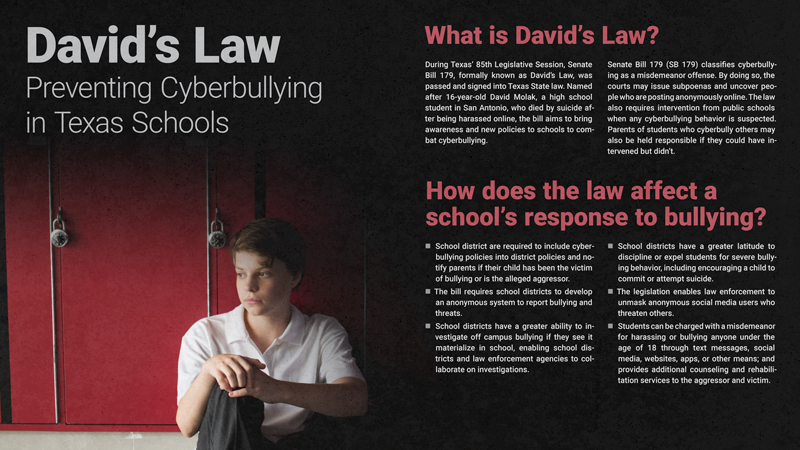
Furthermore, in an effort to tackle the growing concern of off-campus cyberbullying, the Great State of Texas has introduced SB 179, also known as David’s Law. David’s Law is Texas’ new anti-bullying law that specifically addresses cyberbullying. Under this law, school districts are required to include cyberbullying in their district bullying policies. This proactive measure ensures that schools are equipped with the necessary guidelines to tackle cyberbullying effectively. Additionally, the law also mandates that schools notify parents within a reasonable amount of time after an incident of cyberbullying is reported. This timely notification ensures that parents are aware of the situation and can take appropriate action to support their child. Furthermore, schools have the authority to investigate cyberbullying incidents and can collaborate with law enforcement to address such cases, safeguarding the well-being of students.
Here are some other charges that apply to the laws on Cyberbullying:
- Identity theft, password theft, or hacking can violate state and federal laws
- It is punishable to possessing or distributing child pornography. Sexting or forwarding a sext (text messages with sexual content) is considered pornography, If convicted, a sexter may be required to register as a sex offender, even if they’re a minor. Recently, the Governor of Texas, Greg Abbott signed a bill into law making it class C misdemeanor to electronically transmit sexually explicit material without the recipient’s consent.
- An arrest can be made if you as an adult perpetrates or allows cyberbullying, which results in a felony or misdemeanor if convicted.
- When charged with cyberbullying in the U.S. it can result in a charge of juvenile delinquency or a misdemeanor cyber-harassment charge.

While these laws provide a framework for addressing cyberbullying in Texas, it is essential to emphasize the importance of awareness and prevention. It is incumbent upon individuals, families, and communities to actively work towards building a better online and offline world, free from the harms of cyberbullying. One of the best practices to combat this issue is to bring awareness to the problem. Through education and open conversations, individuals can better understand the impact of cyberbullying and learn how to prevent and respond to it. Schools play a pivotal role in spreading awareness and educating students, parents, and educators about cyberbullying and its consequences. By fostering an environment where open dialogue is encouraged, schools can equip students with the knowledge and skills to protect themselves and their peers.
Furthermore, it is crucial to recognize that cyberbullying can have severe psychological consequences, sometimes even leading to suicidal thoughts. If someone you know is feeling suicidal, it is vital to seek immediate help. In the United States, the National Suicide Prevention Lifeline can be reached at 1-800-273-TALK (1-800-273-8255), offering assistance and support. Alternatively, organizations such as the International Association for Suicide Prevention (IASP) and Suicide.org provide helpline numbers for various countries, ensuring that individuals worldwide have access to the help they need.
In conclusion, the Texas Education Code 37.0832 and SB 179, also known as David’s Law, demonstrate the commitment of the state of Texas to tackle the issue of cyberbullying. These robust laws aim to provide a safer environment for students by addressing cyberbullying within schools and beyond. However, it is important to remember that laws alone cannot eradicate this issue entirely. It is incumbent upon individuals, families, schools, and communities to actively work together to create a better, more harmonious world, both online and offline. By raising awareness, educating ourselves and others, and supporting those in need, we can take significant strides towards eliminating the menace of cyberbullying.
 Luna Bella Media